
 Austria
Joint OECD-IOTA Event ‘Regional Seminar on International Tax Developments for Europe and Central Asia’
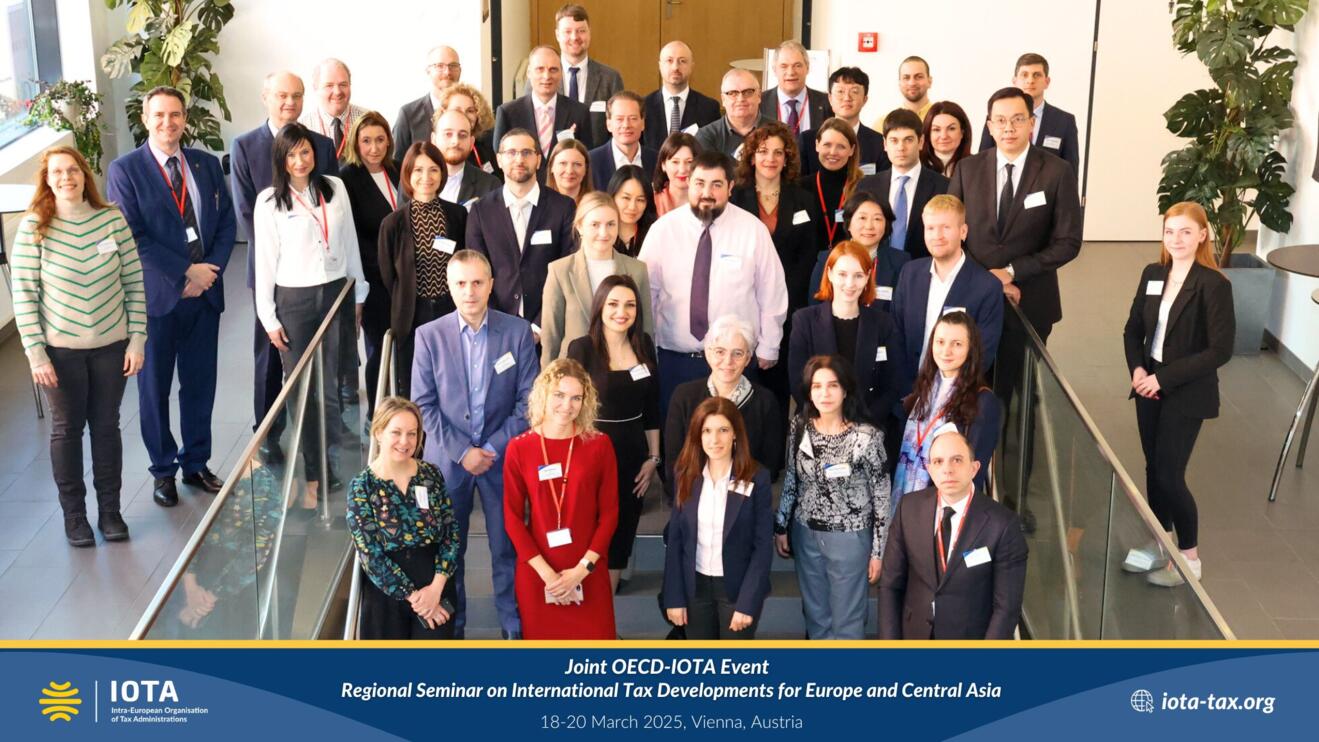
On March 18-20, 2025, IOTA successfully organised another insightful event as part of the IOTA 2025 Work Programme Activities and the Organisation for Economic Co-operation and Development (OECD) regional outreach support initiatives. This joint event, titled Regional Seminar on International Tax Developments for Europe and Central Asia, aimed to ensure that both members and non-members of the OECD/G20 Inclusive Framework on BEPS are updated on the latest international tax developments. The two-and-a-half-day seminar was held in person at the OECD’s Multilateral Tax Centre (MTC), hosted by the Austrian Federal Academy of Finance in Vienna.
The seminar gathered 40 delegates from 24 different tax jurisdictions across Europe and Central Asia, including senior tax policymakers and officials from tax administrations. These participants represented both members and non-members of the Inclusive Framework on BEPS.
Europe and Central Asia are now, more than ever, at the heart of changes in the international tax landscape. Tax policymakers and administrators face the challenge of promoting growth and investment while continuing to generate the revenues needed for development priorities through enhanced domestic resource mobilisation. The region is characterised by unique circumstances, vulnerabilities, and priorities, which form the basis for a regional dialogue on international tax cooperation. The event focused on the implementation of Pillar 2, discussing emerging issues, challenges encountered thus far, various administrative aspects, and the EU Minimum Tax Directive. Sessions addressed the importance and benefits of implementing Country-by-Country (CbC) reporting, particularly for developing countries, as well as issues related to tobacco taxation. Additionally, participants received updates on the upcoming Inclusive Plenary meeting, other key meetings, and capacity-building activities related to international tax cooperation and tax policy.
The seminar began with welcome remarks from the hosts—the Austrian Federal Academy of Finance, IOTA, and the OECD Secretariat—who outlined the agenda and highlighted the meeting's objectives.
Following the introductory remarks, there were roundtable discussions on current and future international tax priorities. This session was led by Laura Stefanelli, Senior Advisor, BEPS Coordination Team at the OECD, and focused on the current state of international taxation, the future of international cooperation on tax matters, and key priorities for fostering domestic resource mobilisation. It aimed to identify capacity-building needs, strengthen developing countries’ engagement in the international tax dialogue, highlight obstacles to implementing international tax standards, and promote cooperation with development partners regarding future priorities.
The next session, led by Alexandros Roukalis, International Taxation Expert at IOTA, discussed the benefits and challenges associated with the implementation status of Country-by-Country reporting. Laura Stefanelli provided updates on the implementation of CbC reporting, covering the benefits for jurisdictions receiving these reports, tools available to assist tax administrations in utilising them, and support provided for jurisdictions—especially developing countries—in implementing the various components of this standard. Participants also engaged in a panel discussion where they shared their feedback on the usefulness and challenges of affection exchange of CbCR. The variety of participating delegates, coming from both tax administrations that have recently adopted the BEPS 13 minimum standard, and others who joined since the initial exchange in 2017, created a very interesting mixture of feedback.
The day concluded with an overview of recent administrative guidance on GloBE rules and GMT and the list of qualified rules released under the transitional qualification mechanism. It provided updates on ongoing work related to simplifications and technical issues. This session was delivered by the OECD Secretariat, facilitated by Laura Stefanelli, and featured speakers Felicie Bonnet, Head of the OECD’s International Tax Coordination Unit, and Andrea Sollecito, Tax Advisor in that unit.
The second day of the seminar began with an overview of recent updates concerning the administration of the Global Minimum Tax. This included the updated GloBE Information Return and the Multilateral Competent Authority Agreement, presented by the OECD Secretariat. The session was moderated by Laura Stefanelli, who was joined by speakers Felicie Bonnet and Andrea Sollecito. The OECD Secretariat also discussed the Inclusive Framework initiatives aimed at promoting tax certainty and efficient, coordinated administration of the Global Minimum Tax. During this session, countries that have made significant progress in implementation were also invited to share their experiences, particularly regarding administrative aspects.
The last session of the day focused on the EU Minimum Tax Directive, moderated by IOTA’s Alexandros Roukalis. He was joined by Francesco Bungaro, a WP11 delegate from the European Commission DG Taxud, Pillar 2 Team, who provided an overview of the EU Minimum Tax Directive (Council Directive 2022/2523). This presentation explored the directive's key provisions, objectives, and implications for member states in aligning with global tax standards.
On the last day of the event, a session focused on taxation in the tobacco sector was moderated by Jonathan Heath, an International Taxation Expert at IOTA. He was joined by Céline Colin, a tax economist from the Country Tax Policy Unit, Tax Policy and Statistics Division at the OECD. During her presentation, the OECD Tax Policy and Statistics Division shared the upcoming work on tobacco taxation in South-East Europe, covering the six Western Balkan economies—Albania, Bosnia and Herzegovina, Kosovo, Montenegro, North Macedonia, and Serbia—as well as Bulgaria, Croatia, and Romania. The session highlighted the importance of tobacco taxes for health and revenue goals, common tax policy and administrative design challenges, and how the OECD can assist jurisdictions in improving the taxation of tobacco products.
Next, the implementation of the Global Minimum Tax was addressed. The session was facilitated by Laura Stefanelli, along with members of the OECD Secretariat. In this session, they addressed ongoing work related to qualified status, which included developing a comprehensive legislative review and the implications of providing benefits related to the rules.
At the conclusion of the seminar, the OECD’s Laura Stefanelli and IOTA’s Alexandros Roukalis recapped the primary takeaways from the two-and-a-half-day event. Additionally, an update was provided on the OECD Secretariat’s significant initiatives and future events, highlighting the Inclusive Framework plenary meeting planned for April in Cape Town, South Africa.
Throughout the seminar, participants were encouraged to consider guiding questions in preparation for the consultation and to share their countries' experiences, perspectives, needs, priorities, and challenges. All the materials, presentations, and photo gallery are now available online on the event’s webpage. This regional seminar was facilitated by Alexandros Roukalis, IOTA’s International Taxation Expert, with support from his colleague Jonathan Heath, under the supervision of the OECD’s Laura Stefanelli, Félicie Bonnet, and Andrea Sollecito.