



IOTA Forum on Tax and Customs Data Science “From Data Governance to AI Governance”
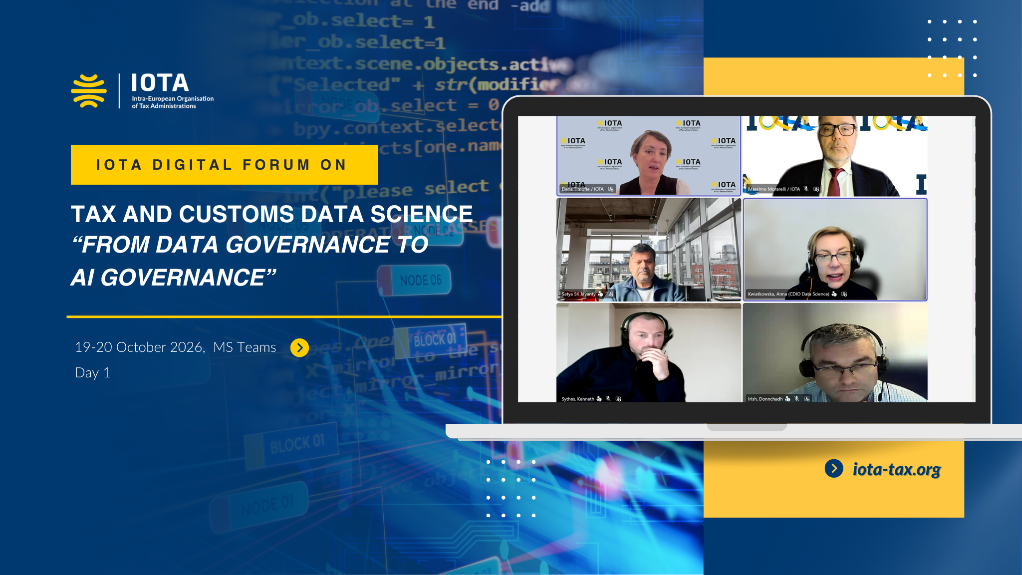
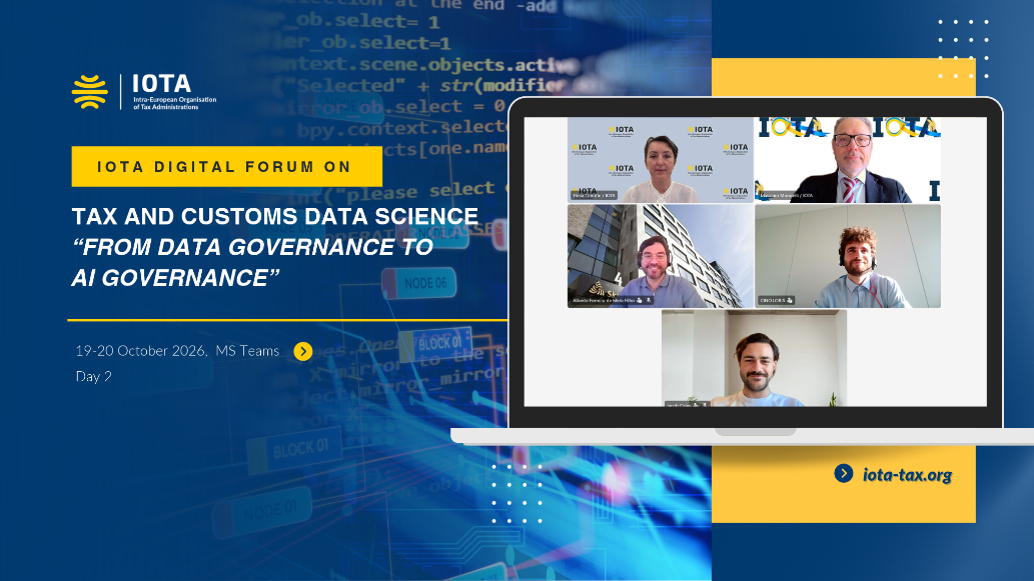
On 19–20 October 2026, IOTA organised the second meeting of the IOTA Forum on Tax and Customs Data Science as a digital event via Microsoft Teams, under the theme “From Data Governance to AI Governance.” The two-day meeting attracted more than 150 digital participants from IOTA member tax administrations and brought together expert perspectives and practical examples to explore how tax administrations can strengthen data governance, build trustworthy AI frameworks and use artificial intelligence responsibly to improve compliance management, fraud detection and other administrative processes.
The Forum provided a platform to exchange experiences, discuss organisational and technical challenges, and examine how effective governance and collaboration can support the responsible adoption of AI in tax and customs administrations.
Connecting Data Governance and AI Governance
The first day focused on the foundations of effective data and AI governance, highlighting the importance of reliable data management, clear accountability and organisational readiness in developing trustworthy AI solutions.
Satya Jayanty, Data Advisory, Governance & Architecture and DAMA Mentor from the United Kingdom, opened the substantive programme with a presentation on building trusted data and responsible AI governance for modern tax and customs administration. Anna Kwiatkowska from His Majesty’s Revenue and Customs (HMRC), United Kingdom, followed with a practitioner’s perspective on building trustworthy AI.
The programme then turned to practical experiences from tax administrations. Donnchadh Irish and Kenneth Sythes from the Office of Revenue Commissioners, Ireland, presented their Governance Journey to the Cloud, exploring data governance practices in tax administration. Anne Kathrine Selsvik from the Norwegian Tax Administration shared an example of moving from manual workflows towards semi-automated analysis and preparing data foundations for analytics and AI models.
The day concluded with a panel debate on how to ensure effective governance, bringing together Satya Jayanty, Anna Kwiatkowska, Kenneth Sythes and Donnchadh Irish. The discussion examined barriers to AI adoption, including data silos, ethics, privacy, security, infrastructure, skills and accountability, as well as the governance controls and organisational support needed to address these challenges.
AI Governance Frameworks and Practical Use Cases
The second day shifted the focus towards AI governance frameworks, sustainable AI practices and practical applications of AI in compliance risk management.
Georgiana Marsic, Head of Data and AI Assurance at Lloyds Banking Group, presented an AI governance framework, addressing principles, safeguards and lifecycle management for the responsible development and deployment of sustainable generative AI solutions.
Alberto Ferreira de Melo Filho from the Swedish Tax Agency presented the Agency’s Advisory Council for Sustainable AI, demonstrating an organisational approach to responsible AI implementation and managing ethical and social risks.
The meeting also explored AI-enabled tax investigation and fraud detection. Jacob Coles from Redfield Co. presented From Documents to Networks: Graph-Based RAG for Tax Investigation, while Loris Cino from the Italian Revenue Agency shared an approach to AI-powered VAT fraud identification. These case studies highlighted the potential of emerging technologies and network-based analysis to help tax administrations identify risks and improve compliance activities.
A panel debate brought together Georgiana Marsic, Alberto Ferreira de Melo Filho, Jacob Coles and Loris Cino to discuss stakeholder collaboration in building AI models. The exchange highlighted the importance of bringing together tax experts and technical, legal and ethical perspectives when designing effective AI solutions.
Future Priorities and Continued Cooperation
The Forum concluded with an open debate on the IOTA Forum on Tax and Customs Data Science's future work. Participants, members of the Forum’s Steering Group and the IOTA Secretariat were invited to identify priority topics and opportunities for further collaboration.
Across the two days, the discussions emphasised that the responsible use of AI depends not only on technological capabilities but also on strong data foundations, clear governance arrangements, appropriate safeguards and effective cooperation between stakeholders. The practical examples speakers shared demonstrated different approaches to addressing these challenges and applying data-driven solutions in tax administration. The Forum will continue to provide a platform for IOTA members to exchange experiences, share good practices and explore future developments in tax and customs data science. All materials, presentations, and the video recordings will be made available soon on the event's webpage. This event was facilitated by the IOTA International Experts Elena Timofte and Massimo Morarelli.