



IOTA Workshop Explores the Use of Exchanged Foreign Asset Information in Tax Enforcement Procedures
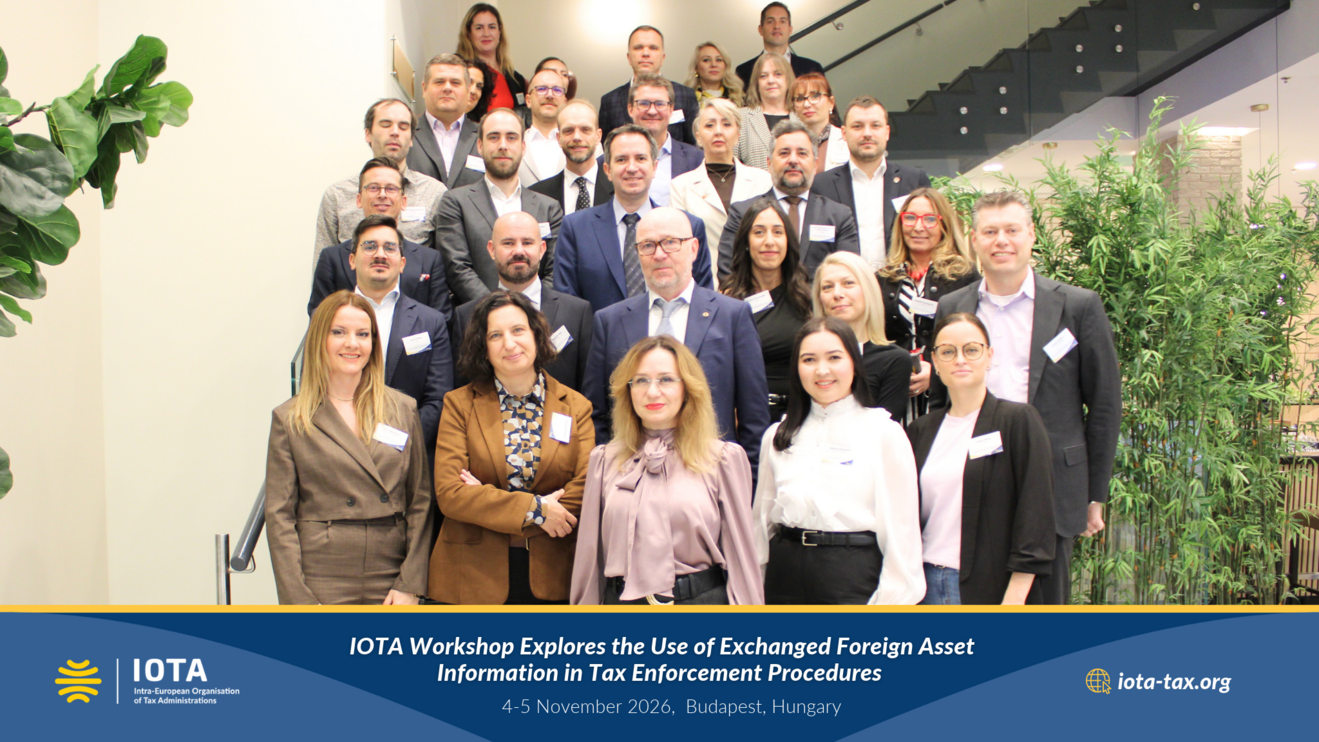
On 4–5 November 2026, IOTA organised a Workshop on the “Use of Data Received through (Spontaneous or Automatic) Exchange of Information on Foreign Assets in Enforcement Procedures” in Budapest, Hungary. The two-day event brought together 29 experts from IOTA member tax administrations, to exchange practical experiences and explore how information received through international exchange mechanisms can support more effective tax debt management and enforcement.
As tax administrations gain access to increasing amounts of information on assets held abroad, the effective use of this data is becoming an important element of cross-border tax debt recovery. The Workshop provided a platform to examine how exchanged information can help identify debtors’ foreign assets, improve risk assessment, support earlier intervention and strengthen recovery actions across jurisdictions.
From Exchanged Information to Effective Tax Recovery
The first day opened with a keynote presentation by Raynald Vial of the OECD Global Forum, who explored the growing role of exchange of information in tax debt management and enforcement, including opportunities for leveraging foreign asset information to improve tax recovery.
Country presentations then provided practical insights into the use of automatically and spontaneously exchanged information. Gert Jan Jue and Frank Gielen from the Netherlands shared a national perspective on the practical use of foreign asset data, while Mattias Westin from Sweden addressed confidentiality requirements and restrictions on the disclosure and use of received foreign information.
Further contributions examined the role of exchange of information and cross-border assistance in the recovery of tax claims, with Dr Katalin Kanizsai from Hungary sharing country experience in this area. Vitalija Burdeinaja from Lithuania highlighted the importance of involving tax debt recovery functions in international tax cooperation frameworks at an earlier stage.
Participants also took part in interactive group discussions, comparing national approaches and identifying opportunities and barriers to using exchanged information throughout the tax debt lifecycle.
Addressing Practical Challenges and Embracing Innovation
The second day focused on the challenges that tax administrations encounter when translating exchanged information into effective enforcement actions. Discussions addressed legal, technical, organisational and data-related barriers, as well as possible solutions and lessons learned.
Erik Karlsson from Sweden shared experience on overcoming data-related challenges in tax recovery, while Paul Van Der Smitte, Senior Adviser at ACCS International, presented a private-sector perspective on debt management, information sharing and the importance of building trust.
The programme continued with country experiences from Portugal, Norway and Bosnia and Herzegovina. Carlos Borges from Portugal explored the challenges of automation in enforced collection and the role of international cooperation. Marcus Haugen Kristiansen from Norway presented approaches to risk-based tax debt collection, including the use of advanced analytics and automation. Ena Šeremet from Bosnia and Herzegovina shared experience on cross-border debt collection involving the bankruptcy of a foreign parent company and a registered tax representative.
A second round of group discussions provided an opportunity to examine how exchanged data can be integrated into IT systems and risk models, and how cooperation between jurisdictions can be strengthened in cross-border debt recovery.
Looking Ahead: Strengthening Cooperation and Making Better Use of Data
The Workshop concluded with an interactive panel debate featuring Raynald Vial of the OECD Global Forum, Ena Šeremet from Bosnia and Herzegovina, Dr Katalin Kanizsai from Hungary and Carlos Borges from Portugal.
Building on the two days of discussions, panellists and participants reflected on the legal, operational, technical and organisational changes needed to make more effective use of exchanged information in enforcement procedures. Key questions included how to use information earlier in the tax debt lifecycle, which investments in technology and analytics could deliver the greatest benefits, and how to further strengthen international cooperation.
The Workshop highlighted that access to foreign asset information alone is not sufficient: tax administrations also need appropriate legal and organisational frameworks, reliable data, effective analytical capabilities and strong cooperation mechanisms to translate information into successful recovery actions. All materials, presentations, and the video recordings will be made available soon on the event's webpage. This event was facilitated by the IOTA International Experts Anders Öbrink and Alexandros Roukalis.